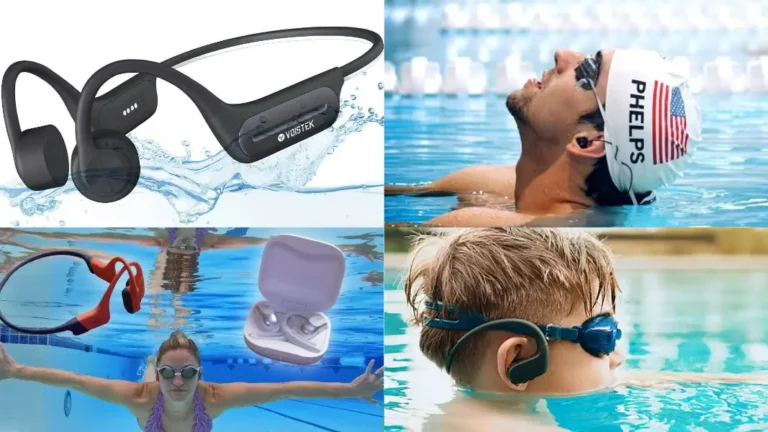
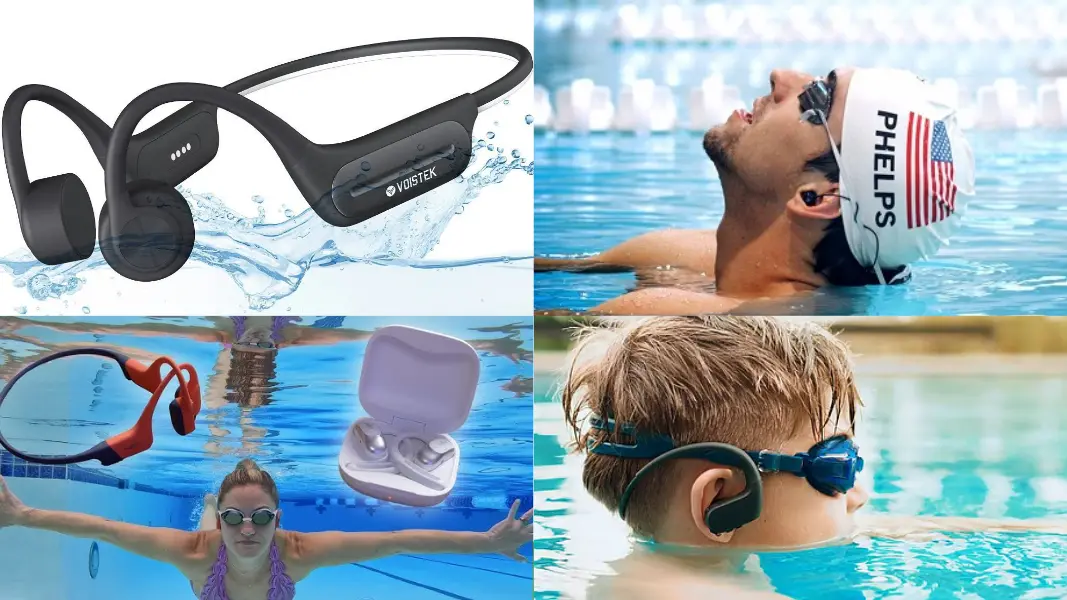
Swimming is one of the few workouts where your mind has nowhere to go. You stare at a black line for an hour. Your thoughts drift. Music changes that. The right swimming headphones turn boring laps into a rhythm you can hold, and they keep long sessions from feeling endless.
But underwater audio is hard. Water blocks signals. Earbuds slip out during flip turns. Cheap “waterproof” gear dies after a month of chlorine. Most swimmers learn this the expensive way.
This guide fixes that. We have tested swimming headphones across pool sessions and open water, from quick 30-minute lap sets to two-hour endurance swims. Below, you will learn how these devices work, which waterproof rating actually matters, why Bluetooth fails underwater, and which models are worth your money in 2026. You will also get clear picks for budget, premium, triathlon, and open water use.
What Are Swimming Headphones?
Swimming headphones are audio devices built to keep working while fully underwater. They survive submersion, resist chlorine and saltwater, and stay fixed to your head during fast strokes.
Most use one of two designs. The first is bone conduction technology. The second is sealed waterproof earbuds. Both solve the same problem in different ways. We will compare them shortly.
These are not the same as gym headphones. A normal pair will drown in seconds.
How do they differ from Regular Headphones?
Regular headphones are built for air. Swimming headphones are built for water. That single difference changes everything about their design.
Clearly, the biggest gap is the waterproof rating. Standard earbuds carry sweat resistance at best. True swimming headphones carry an IP68 or IPX8 rating, which means full submersion.
Moreover, swimming headphones store music inside the device. They do not rely on Bluetooth alone, because Bluetooth cannot reach your phone through water. Most regular headphones have no internal storage at all.
The fit also differs. Swimming headphones wrap around your head or clip to your goggle straps. They are engineered to survive flip turns, push-offs, and the drag of moving water. A loose earbud is gone the moment you dive.
Who Should Use Swimming Headphones?
Swimming headphones suit almost any swimmer who wants music or podcasts in the water. Some groups benefit more than others.
- Recreational swimmers who want laps to feel less repetitive.
- Competitive swimmers who train for hours and need motivation.
- Triathletes who want one device for swimming, cycling, and running.
- Fitness enthusiasts who use the pool for low-impact cardio.
- Open water swimmers who want awareness of their surroundings.
What’s more, anyone recovering from a joint injury often turns to swimming. Audio makes that slow, careful rehab far easier to stick with.
Now that the use case is clear, let us look under the hood.
How Swimming Headphones Work?
Underwater audio is a physics problem. Sound and wireless signals behave very differently in water than in air. The best swimming headphones are designed around these limits, not against them.
There are four pieces of technology you need to understand: bone conduction, sealed waterproof earbuds, MP3 storage, and Bluetooth. Each plays a role in how your music reaches your ears.
Bone Conduction Technology Explained
Bone conduction is the technology behind most modern swimming headphones. Instead of pushing sound into your ear canal, it sends sound through your cheekbones.
Small transducers rest on the bone in front of your ears. They vibrate. Those vibrations travel through your skull straight to your inner ear. Your eardrum is barely involved.
This open-ear design has two big advantages for swimmers. First, your ear canal stays open, so water does not muffle the sound. Second, you keep situational awareness. You can hear a coach, a lifeguard, or another swimmer.
Brands like Shokz, FINIS, and H2O Audio have refined this open-ear design for years. It has become the default for serious swim training.
Traditional Waterproof Earbuds
The second design is the sealed waterproof earbud. These plug into your ear canal and block water out with a tight tip.
Their main strength is sound isolation. Because the earbud seals the canal, bass feels fuller, and audio quality is richer than bone conduction. Sony has built a respected line of sealed waterproof players around this idea.
However, sealed earbuds carry a trade-off. They cut you off from your surroundings, which can be risky in open water. They are also more likely to work loose during aggressive turns. For pure pool focus, though, many swimmers love them.
MP3 Storage Systems
Here is the part most beginners miss. The best swimming headphones store music inside the device itself.
This is the MP3 player built into the unit. You load songs by plugging the headphones into a computer and dragging files across. Once loaded, the music plays directly from internal storage. No phone is needed.
Storage size matters. A 4GB model holds roughly 1,000 songs. A 32GB model like the Shokz OpenSwim Pro holds around 8,000 tracks. For most swimmers, even 4GB is plenty for a year of workouts.
MP3 storage is the reason swimming headphones work at all underwater, which brings us to Bluetooth.
Bluetooth Technology Limitations Underwater
Bluetooth is the standard for wireless audio on land. Underwater, it fails almost completely.
Bluetooth uses 2.4GHz radio waves. These waves travel well through the air but get absorbed by water within centimeters. The moment your head goes under, the signal between your phone and your headphones is cut.
This is why pure Bluetooth earbuds are useless for swimming. They will skip, stutter, and drop the second you submerge. Even keeping your phone at the pool edge will not save the signal once your head is wet.
Most importantly, this is why true swimming headphones offer a dual-mode design. They use Bluetooth on land and switch to internal MP3 storage in the water. The Shokz OpenSwim Pro, for example, toggles between Bluetooth V5.4 and MP3 mode with a button hold.
So Bluetooth is not useless. It just cannot be your only option. Now, let us turn that knowledge into a buying checklist.
Key Features to Look for in the Best Swimming Headphones
Buying swimming headphones is easy once you know which specs actually matter. Marketing pages’ love to bury the important numbers. Focus on these seven features, and you will not waste money.
Waterproof Ratings (IP68 vs IPX8)
The waterproof rating is the single most important spec. Get this wrong, and your headphones die.
IP ratings come from the IEC 60529 standard. The format is “IP” followed by two characters. The first character covers dust protection. The second covers water protection.
- IP68 means the device resists dust completely and survives submersion beyond one meter. The Shokz OpenSwim Pro holds IP68 and can sit in two meters of fresh water for two hours.
- IPX8 means water protection was tested, but dust was not rated. The “X” simply means no dust test. IPX8 still means deep submersion, so it is fine for swimming.
For swimming, you want IP68 or IPX8. Anything lower, like IPX4 or IPX7, is meant for sweat or rain, not laps. Do not trust a vague “waterproof” label with no rating behind it.
Battery Life
Battery life decides how long you can train. Most swimming headphones offer six to nine hours of playback.
That sounds short, but it is plenty. Few people swim longer than two hours at a stretch. The Shokz OpenSwim Pro gives nine hours in Bluetooth mode and six in MP3 mode. The FINIS Duo and H2O Audio Sonar both last around seven hours.
Look for fast charging too. A ten-minute top-up on the OpenSwim Pro returns about three hours of playback. That is a lifesaver before an early session.
Storage Capacity
Storage matters only if you swim without your phone, which is most of the time underwater.
- 4GB holds about 1,000 songs. Good for casual swimmers.
- 8GB holds about 2,000 songs. A safe middle ground.
- 32GB holds about 8,000 songs. Overkill for many, but great if you also use the headphones for running or hiking.
If you mostly stream podcasts on land and play music in the pool, mid-range storage is enough.
Comfort and Fit
A secure fit is non-negotiable. Headphones that shift mid-stroke ruin a workout.
Bone conduction models use a wraparound band, often a nickel-titanium alloy, which flexes but holds shape. The OpenSwim Pro weighs only 27 grams, so you barely feel it. Clip-on models like the FINIS Duo attach directly to your goggle straps for a fixed hold.
Try the headphones with your swim cap and goggles together. Put the headphones on first, then pull the cap over the ear hooks. This keeps everything locked in place.
Audio Quality
Audio quality underwater will never match studio headphones. Manage your expectations.
Bone conduction gives clear mid-range sound, which suits podcasts and vocals well. Bass is weaker because vibrations lose energy underwater. Sealed earbuds deliver richer bass but block your surroundings.
A simple trick helps. Wearing swim earplugs with bone conduction headphones makes the sound noticeably fuller because it reduces water interference in the ear canal.
Durability
Durability is what separates a one-season toy from a multi-year tool. Chlorine and saltwater are corrosive.
Look for a triple-sealed build and corrosion-resistant materials. After saltwater swims, rinse the headphones in fresh water. The OpenSwim Pro guide even recommends soaking them for about 30 minutes after ocean use to clear the salt.
Ease of Use
Finally, ease of use matters more than people admit. You will use these with wet hands, often in a hurry.
Large physical buttons beat tiny touch controls in the water. Simple drag-and-drop file loading beats clunky proprietary software. A companion app for switching playlists, like the Shokz app, is a nice bonus, but should never be required just to play music.
With the checklist set, here is how the leading models compare.
Best Swimming Headphones Compared
The table below summarizes the top swimming headphones for 2026. Prices are approximate and shift with sales, so always check current listings before buying.
| Model | Type | Waterproof | Battery | Storage | Connectivity | Best Use Case | Price (approx) |
| Shokz OpenSwim Pro | Bone conduction | IP68 (2m) | 9h BT / 6h MP3 | 32GB | Bluetooth 5.4 + MP3 | Best overall, pool and land | $180 to $200 |
| H2O Audio Sonar | Bone conduction | IPX8 | About 7h | 8GB | MP3 + Bluetooth | Goggle clip under $100 | About $100 |
| FINIS Duo | Bone conduction | IPX8 | About 7h | 4GB | MP3 only | Budget pool laps | $60 to $80 |
| H2O Audio Tri 2 Pro | Bone conduction | IPX8 | About 8h | 8GB | Bluetooth 5.3 + MP3 | Triathlon and comfort | About $199 |
| Zygo Z2 | Bone conduction with transmitter | Waterproof | Varies | Streams live | Poolside transmitter | Coaching and structured training | Premium plus subscription |
| Sony sealed waterproof player | Sealed in-ear | IP65/IP68 | Varies | 4GB to 8GB | MP3 | Rich sound isolation | Premium |
Use this as a starting map. Now let us break the field down by budget and swimmer type.
Best Affordable Swimming Headphones
You do not need to spend a fortune to enjoy music in the pool. Budget swimming headphones have come a long way.
The FINIS Duo is the classic value pick. It clips two small pods to your goggle straps. They rest on your cheekbones and use bone conduction. At roughly $60 to $80, it offers a player, headphones, and a stable fit in one simple package. It has no Bluetooth, but for pure pool laps, you rarely need it.
The H2O Audio Sonar sits just above it at around $100. For the extra cost, you get 8GB of storage and both MP3 and Bluetooth. It clips to your goggles and even pairs with an Apple Watch poolside.
Clearly, the value here is strong. You give up some storage and premium polish, but the core experience holds up. For most recreational swimmers, an affordable pair is all they will ever need.
If your budget stretches further, the premium tier adds real refinement.
Best Premium Swimming Headphones
Premium swimming headphones earn their price through better build, more storage, and smarter features. They are aimed at swimmers who train often.
The Shokz OpenSwim Pro leads this group. It carries IP68 waterproofing, a flexible nickel-titanium frame, and a massive 32GB of storage. Its standout feature is true dual mode. You stream Bluetooth on land, then toggle to MP3 in the water. This makes it as useful on a morning run as in the pool.
For structured training, the Zygo Z2 offers something unique. It streams audio from a transmitter placed at the poolside, so you never load files. The same system pipes live coaching sessions to your ears, similar to a connected fitness class but for swimming. The deep app ecosystem includes lap counting and a poolside walkie-talkie feature, though premium features sit behind a subscription.
Moreover, sealed players from Sony appeal to swimmers who care most about sound quality. Them in-ear seal delivers fuller bass than bone conduction can manage.
Premium gear shines for frequent swimmers. Multi-sport athletes have their own ideal pick.
Best Swimming Headphones for Triathletes
Triathletes need one device that handles swimming, cycling, and running. Comfort over long sessions is critical.
The H2O Audio Tri 2 Pro is built for exactly this. It is very light at about 1.12 ounces and holds an IPX8 rating for deep submersion. It supports both MP3 and Bluetooth, so it adapts to each leg of training. Its Playlist+ feature lets you capture and replay audio offline.
The Shokz OpenSwim Pro is also a strong triathlon choice. Its dual-mode design and open-ear awareness suit road running and cycling, where hearing traffic keeps you safe.
What’s more, both models keep your ears open. For a triathlete on a busy road, situational awareness is not a luxury. It is a safety feature. Speaking of safety, open water demands its own approach.
Best Swimming Headphones for Open Water Swimming
Open water swimming raises the stakes. There are no lane lines, no walls, and often no lifeguard nearby. Your headphones should support your awareness, not block it.
Bone conduction is the clear winner here. Because your ear canal stays open, you can still hear boats, kayakers, and other swimmers. Sealed earbuds cut you off, which is risky in the ocean or a lake.
The Shokz OpenSwim Pro is a top open water pick. Its IP68 rating handles full submersion, its secure frame survives chop, and its open-ear design keeps you alert. Remember to rinse it in fresh water after saltwater swims to prevent corrosion.
The Zygo Z2 also fits structured open water training, especially when paired with coaching feedback.
Most importantly, keep the volume moderate in open water. You need to hear your surroundings at all times. A high-visibility cap and a tow float add further safety.
Before we list common mistakes, one comparison deserves a closer look.
Swimming Headphones Vs Waterproof Earbuds
Many shoppers confuse swimming headphones with waterproof earbuds. They are not the same, and the difference affects your swim.
Comfort: Bone conduction headphones rest outside the ear, so they avoid the pressure of an in-ear tip. Many swimmers find them more comfortable for long sets. Sealed earbuds can feel snug but secure.
Audio quality: Sealed waterproof earbuds win here. The seal blocks water and delivers fuller bass. Bone conduction sounds clear but lighter on the low end.
Safety: Open-ear bone conduction wins. You stay aware of your surroundings. Sealed earbuds isolate you, which is fine in a quiet pool but risky in open water.
Swimming performance: Bone conduction models are built around swimming. They wrap your head or clip to the goggles. Many waterproof earbuds are repurposed gym buds that loosen during turns.
Durability: Both can be durable if rated IP68 or IPX8. The key is the rating, not the form. Always check it.
In short, sealed earbuds suit pool focus and rich sound. Bone conduction suits awareness and all-day comfort. Choose based on where you swim.
Even with the right type, buyers still slip up. Here is how to avoid that.
Common Buying Mistakes to Avoid
Most regret comes from a handful of avoidable errors. I have watched swimmers make all of these.
- Buying Bluetooth-only earbuds. They cannot stream underwater. You need internal MP3 storage. This is the number one mistake.
- Ignoring the waterproof rating. “Water resistant” is not “waterproof.” For swimming, demand IP68 or IPX8.
- Confusing splash resistance with submersion. An IPX4 rating survives sweat, not laps. Read the second digit.
- Overpaying for storage you will not use. 32GB is great for multi-sport users, but wasted on a casual pool swimmer.
- Skipping the fit test. Headphones that work loose mid-stroke ruin the session. Test them with your cap and goggles.
- Forgetting maintenance. Chlorine and salt corrode electronics. Rinse after every swim, or the lifespan drops fast.
- Expecting studio sound. Underwater audio is functional, not audiophile grade. Set realistic expectations.
- Choosing sealed earbuds for open water. They block awareness. In a lake or ocean, that is a safety risk.
Avoid these, and your purchase will last. Good maintenance extends that life even further.
How to Maintain Swimming Headphones?
Maintenance is the cheapest way to protect your investment. Chlorine, salt, and minerals slowly attack electronics. A few habits keep your headphones working for years.
Cleaning Tips
Rinse your headphones in fresh, clean water after every swim. This is the most important step. For saltwater swims, soak them for around 30 minutes to dissolve trapped salt. Wipe them dry with a soft cloth. Never use soap, alcohol, or abrasive cleaners on the transducers or charging contacts.
Storage Tips
Always store your headphones fully dry. Trapped moisture corrodes charging pins. Keep them in the supplied case, away from direct sun and heat. Heat damages both the battery and the seals that keep water out.
Battery Care
Avoid leaving the battery at zero for long periods. Charge them before they fully drain. Do not leave them plugged in for days after a full charge. Use only the supplied magnetic cable, since third-party cables can damage the waterproof charging port.
Extending Product Lifespan
Dry the charging contacts before plugging in. Keep firmware updated through the brand app, as updates often improve battery protection. Handle the band gently and avoid over-bending it. With this routine, a quality pair easily lasts two to three years of regular use.
Many readers still have specific questions. Let us answer the most common ones.
Final Thoughts
Choosing swimming headphones comes down to where you swim, how often, and your budget. To decide quickly, ask yourself three questions. Where do I swim most, pool or open water? Do I also run or cycle? What is my budget? If you swim only in a pool on a tight budget, choose the FINIS Duo. If you want one device for every workout, choose the Shokz OpenSwim Pro. If you train with structure and coaching, look at the Zygo Z2. Whatever you pick, prioritize the waterproof rating, a secure fit, and internal MP3 storage. Get those three right, rinse your headphones after every swim, and your next workout will sound a whole lot better.
Frequently Asked Questions
Can Bluetooth headphones work underwater?
No. Bluetooth uses 2.4GHz radio waves that water absorbs almost instantly. The signal drops the moment your head goes under. This is why real swimming headphones store music internally and switch to MP3 mode in the water.
Are bone conduction headphones good for swimming?
Yes. Bone conduction is the most popular technology for swimming headphones. It sends sound through your cheekbones, keeps your ear canal open, and lets you stay aware of your surroundings. That awareness is a real safety benefit in open water.
Which waterproof rating is best for swimming?
Look for IP68 or IPX8. Both confirm the device survives full submersion. IP68 also confirms dust protection. Avoid lower ratings like IPX4 or IPX7, which only handle sweat or brief contact, not laps.
Can I listen to Spotify while swimming?
Not directly underwater. Streaming apps need a live Bluetooth or internet connection, which fails underwater. The workaround is to download tracks as files and load them onto headphones with MP3 storage, or use a system like the Zygo that streams from a poolside transmitter.
How many songs can be swimming headphones store?
It depends on storage size. A 4GB model holds about 1,000 songs. An 8GB model holds about 2,000. A 32GB model like the Shokz OpenSwim Pro holds roughly 8,000 tracks.
How long do swimming headphones last?
Battery playback usually runs six to nine hours per charge. As a product, a well-maintained pair lasts about two to three years. Rinsing after every swim and storing them dry makes the biggest difference.
Are swimming headphones worth it?
For anyone who swims regularly, yes. They make long sessions more enjoyable and help you train longer. Even budget models around $60 to $80 deliver a strong experience. The key is buying a pair with the right waterproof rating and internal storage.
What are the safest headphones for open water swimming?
Bone conduction headphones with an open-ear design are safest. They let you hear boats, swimmers, and warnings. The Shokz OpenSwim Pro is a popular open water choice thanks to its IP68 rating and secure fit. Keep the volume moderate so you stay aware.