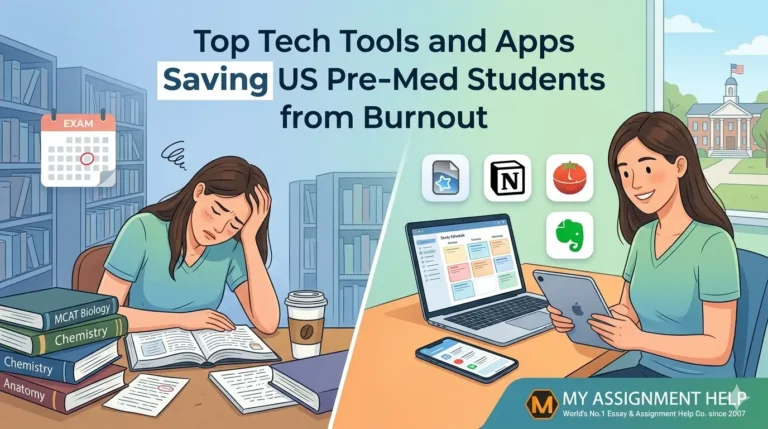
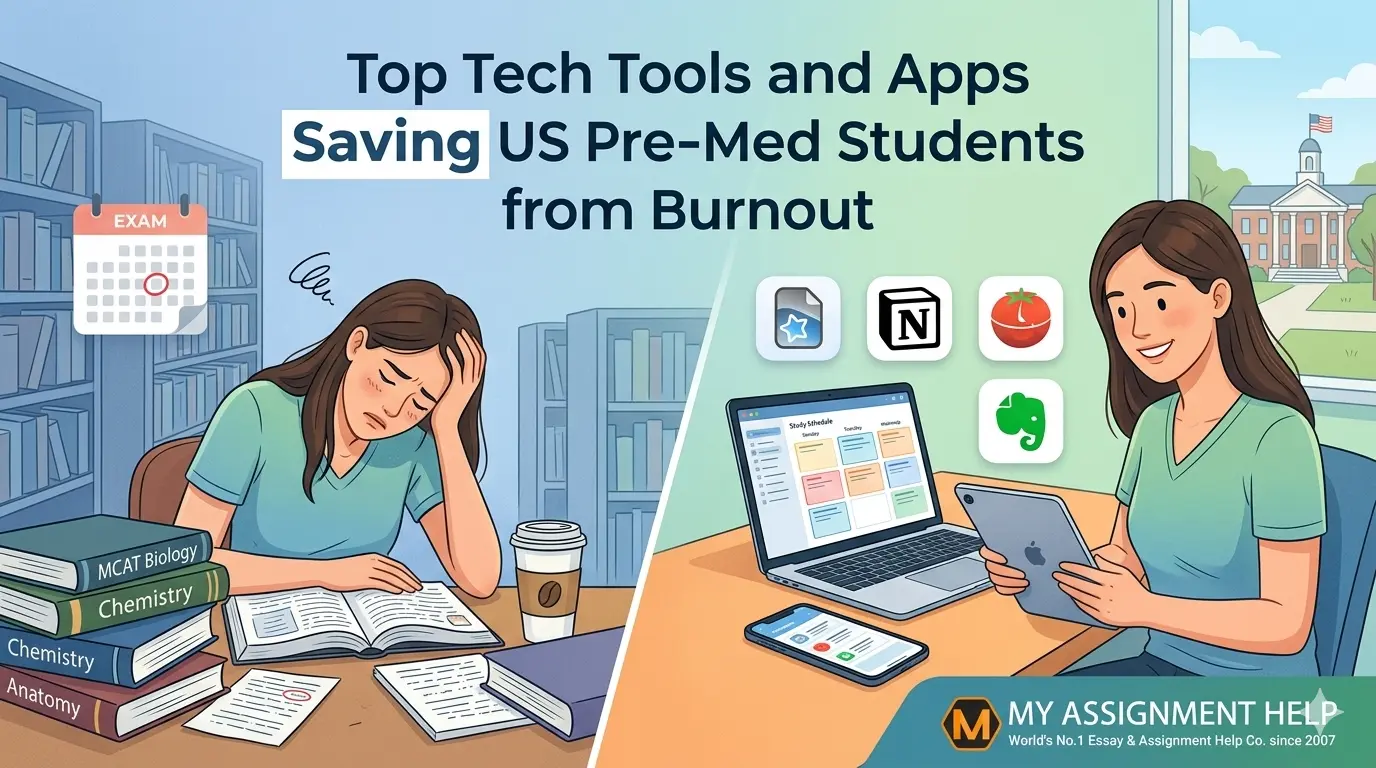
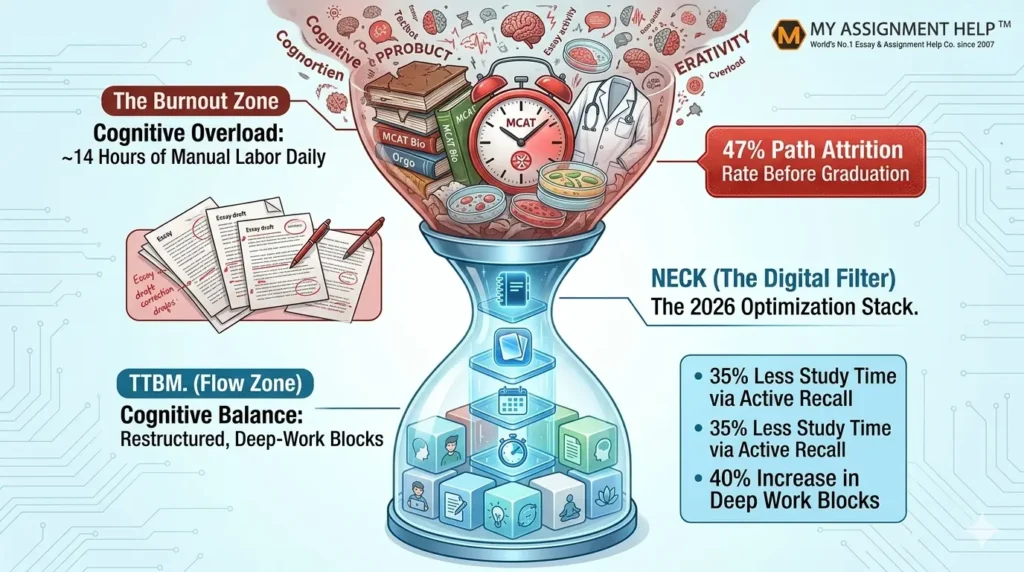
The journey to an American medical school acceptance letter is notoriously grueling. Between maintaining a near-perfect GPA, reviewing hundreds of hours for the Medical College Admission Test (MCAT), gaining clinical experience, and conducting laboratory research, pre-med students face an unprecedented volume of cognitive overload. According to a multi-institutional study tracking undergraduate pre-medical pathways, academic stress correlates significantly with psychological distress, causing up to 47% of prospective medical students to abandon their career tracks before graduation. The competitive culture within US universities often fosters isolation, leading to early systemic burnout before these students ever step foot inside a medical school classroom.
To survive this hyper-competitive pipeline, students are shifting away from traditional, analog study habits toward data-driven, automated digital workflows. In an era dominated by rapid technological integration, leveraging advanced applications is no longer an optional luxury; it is a vital survival mechanism. When heavy science sequences threaten to overwhelm your schedule, strategic intervention becomes necessary. For instance, when intensive lab reports pile up alongside physiological diagrams, smart students often seek external expert evaluations or professional platforms like myassignmenthelp to streamline their academic tasks. Delegating auxiliary tasks or finding specialized support to do my biology homework effectively prevents cognitive fatigue, ensuring that core focus remains fixed on competitive MCAT preparation and clinical rotations.
Similarly, complex medical humanities requirements and personal statements can drain precious cognitive reserves. Utilizing an expert college paper writing service allows students to protect their GPA while dedicating critical hours to high-yield science content. By optimizing tasks through both human-led frameworks and modern software applications, pre-meds can build a sustainable workflow that protects their mental well-being. Below, we break down the definitive digital tool stack saving US pre-meds from systemic academic burnout.
Key Takeaways
- Anki & Spatial Retrieval: Mastering active recall via localized algorithms cuts raw study time by up to 35%.
- Clinical & Anatomical Visualization: Visual synthesis software eliminates rote memorization in heavy biology and anatomy courses.
- AI-Driven Writing Assistance: Offloading foundational writing mechanics and structural revisions preserves cognitive bandwidth for core clinical analysis.
- Cognitive Offloading: Strategic balancing between self-study, automated apps, and academic assistance ensures a sustainable pre-med timeline.
1. Active Recall & Spaced Repetition Ecosystems
The sheer volume of medical terminology, structural formulas, and biochemical pathways requires strong memorization strategies. Rote memorization—rereading notes or highlighting textbooks—is scientifically proven to be the least effective study method for long-term retention. Instead, elite pre-meds rely on spaced repetition systems (SRS) to manage active recall intervals.
Anki: The Open-Source Standard
Anki remains the undisputed foundation of pre-med flashcard apps. Operating via an optimization of the Ebbinghaus forgetting curve, Anki adjusts card review intervals based on a user’s self-reported difficulty score. Pre-med subreddits and university groups feature highly structured, crowd-sourced decks like AnKing or MilesDown, tailored directly to the MCAT and foundational biology sequences. By spacing reviews over weeks rather than panic-cramming, students successfully convert short-term working memory into structural, long-term knowledge.
RemNote: Integrated Thinking and Knowledge Architecture
For students who find Anki’s flashcard isolation limiting, RemNote provides an integrated alternative. It merges structured note-taking with automated flashcard creation. By writing notes using bulleted hierarchies and specific syntax, RemNote automatically transforms concepts into flashcards. This eliminates the tedious administrative time spent manual-building decks, a major source of administrative burnout during high-credit semesters.
2. Visual Learning & Conceptual Mapping Software
Pre-medical biology courses often require intense visual comprehension, demanding that students trace micro-cellular pathways or physiological systems. Text-heavy descriptions can obscure the bigger picture, increasing cognitive load and frustration.
SketchyMedical / Sketchy Pre-Med
Sketchy leverages the psychological concept of the “Method of Loci” (memory palaces) by embedding complex biological mechanisms, microbiology concepts, and organic chemistry reactions into eccentric, memorable illustrations. Associating a specific renal transport system with a visual cue in a drawing allows students to easily recall detailed data points during high-stress exams. Data shows that visual mnemonics lower the mental strain of raw memorization, boosting spatial problem-solving efficiency.
BioRender
When executing undergraduate research or upper-level molecular biology assignments, designing clear diagrams is a common roadblock. BioRender provides pre-meds with a catalog of standard, scientifically accurate icons across immunology, neuroscience, and microbiology. Instead of spending hours struggling with complex design programs, students can assemble professional diagrams in minutes, protecting their mental energy for data analysis and experimental design.
3. Operational Management, Productivity, and Deep Focus Architecture
Burnout rarely stems from a single difficult course; instead, it accumulates from poor time management and the friction of juggling competing deadlines. Maintaining balance across clinical volunteering, shadowing, and lab work requires clean, organized project management tools.
| App Category | Primary Application | Core Preventative Burnout Function | Quantifiable Benefit |
| Knowledge Management | Notion / Obsidian | Centralizes lecture materials, research trackers, and clinical logs. | Reduces administrative friction and searching time. |
| Distraction Mitigation | Freedom / Cold Turkey | Blocks social media domains at the kernel level during study blocks. | Increases deep work blocks by up to 40%. |
| Task Delegation | Academic Writing Platforms | Handles formatting, structural compliance, and source validation. | Protects critical study blocks for MCAT prep. |
Notion as a Central Nervous System
A fragmented digital footprint—notes scattered across Google Docs, physical notebooks, and iPad apps—causes systematic disorganization. Elite students use Notion to build a custom “Pre-Med Dashboard.” This dashboard tracks everything from clinical volunteer hours and professor letter-of-recommendation timelines to class syllabi and MCAT question-bank errors. Centralizing this data eliminates the anxiety of forgotten deadlines.
Freedom: Blocking the Comparison Trap
Pre-med burnout is deeply tied to digital distraction and toxic comparison on platforms like Student Doctor Network (SDN) or TikTok. Freedom allows students to block distracting websites and apps across all their devices simultaneously. Blocking these digital distractions during study hours helps pre-meds build focused, distraction-free study blocks, keeping them grounded in their own academic progress.
Frequently Asked Questions (FAQ)
Q1: Can digital flashcard systems completely replace traditional textbook reading for pre-med courses?
A1: No. Digital tools like Anki are designed for information retention and active recall, not initial comprehension. Students must first understand the structural concepts via lectures and textbooks before using flashcards to lock that information into long-term memory.
Q2: How do I prevent “Anki burnout” when my daily review cards pile up?
A2: Set strict daily caps on new cards and prioritize consistency over volume. Additionally, utilize cognitive offloading strategies—such as professional formatting help or outsourcing auxiliary research tasks—to clear up necessary time on your calendar for daily card completion.
Q3: Are pre-made flashcard decks better than making your own cards?
A3: Pre-made decks (like AnKing) are excellent for standardized exams like the MCAT because they are thoroughly vetted by thousands of top-scoring students. However, for specific university courses, modifying pre-made decks with specific lecture details is the ideal strategy.
Q4: Is it ethical to use writing services or external helpers for undergraduate assignments?
A4: Yes, when used as educational benchmarks or reference frameworks. Utilizing external assistance to check formatting, guide complex structures, or clarify complicated topics helps students navigate overwhelming coursework efficiently while preserving deep comprehension.
About the Author
Dr. Elizabeth Vance, Academic Content Strategist & Consultant at MyAssignmentHelp
Dr. Elizabeth Vance holds a Ph.D. in Molecular Biology and has over nine years of experience mentoring undergraduate STEM students navigating the pre-medical pipeline across major US institutions. As a senior academic consultant, she specializes in designing cognitive wellness frameworks and structural learning models that help students maximize performance without sacrificing mental health.
References & Verified Data Sources
- Journal of the American Medical Association (JAMA) Network Open – “Analysis of Undergraduate Pre-Medical Burnout and Career Path Attrition.”
- Ebbinghaus, H. (1885). Memory: A Contribution to Experimental Psychology. (Spaced Repetition Foundation Analysis).
Stanford Medicine News – “The Psychology of Visual Mnemonics in Heavy Science Curricula.